
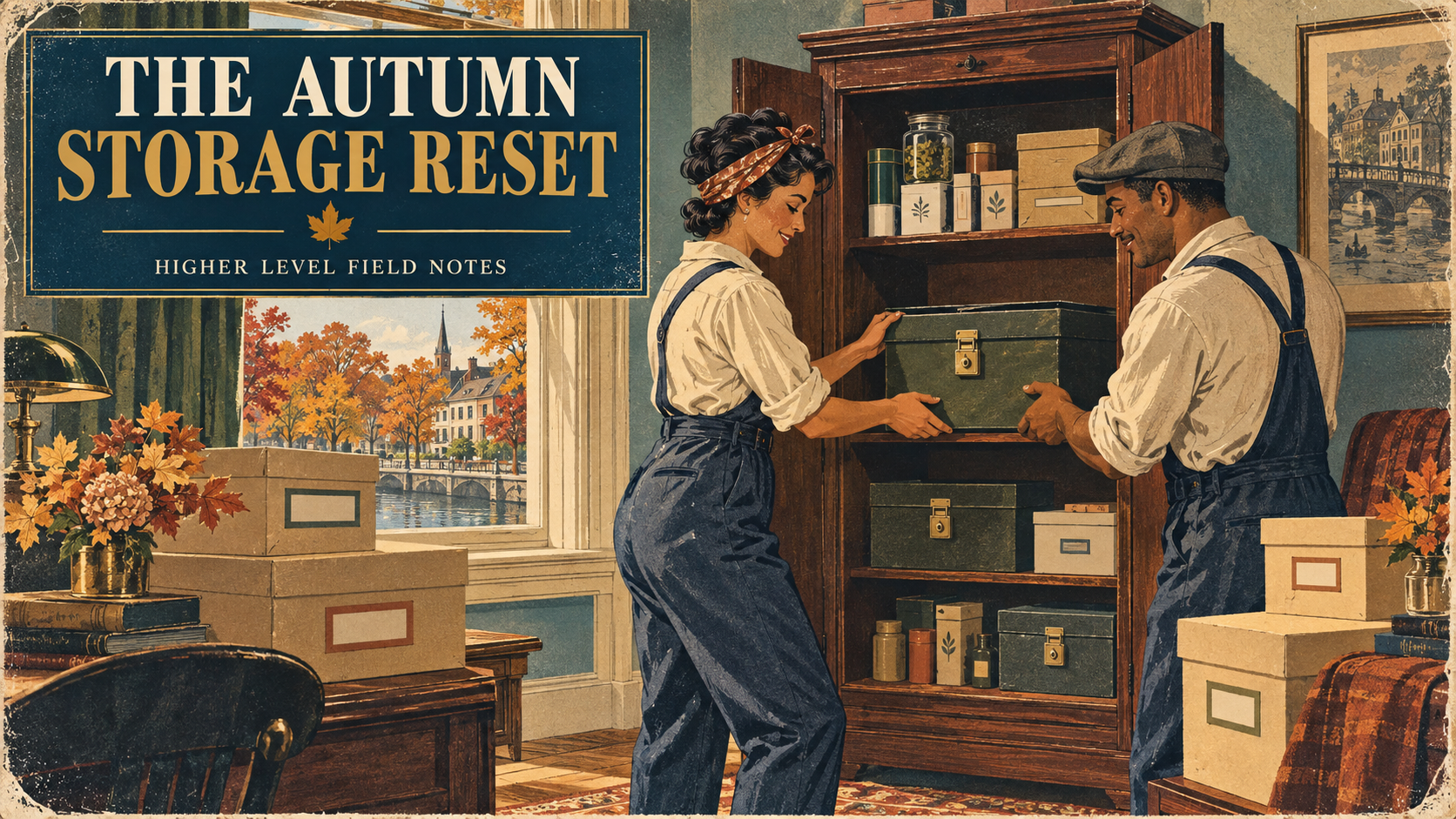
Keep cannabis products in their original, clearly labeled packaging and secure them where children, pets, and visitors cannot access them. Separate infused foods and beverages from ordinary groceries, follow each product’s storage directions, and periodically check packages, dates, devices, and official recall notices.
Autumn has a way of turning our attention inward.
The windows close a little earlier. Coats return to their hooks. Pantry shelves are reconsidered. Summer’s loose collection of picnic supplies, travel bags, and half-finished projects begins making its way back into drawers and cupboards.
It is a natural season for taking stock—and cannabis storage deserves a place in that ritual.
Products purchased at different times can gradually migrate around a home. A package stays in a weekend bag. An edible finds its way into the back of a pantry. A vape cartridge becomes separated from its box. A label fades, a seal loosens, or a once-organized drawer becomes difficult to navigate.
The Autumn Storage Reset is a chance to bring everything back together, read what is actually on the packaging, and create a system that is both easier to use and safer for everyone who shares the space.
This is not about building an elaborate collection. It is about knowing what you have, where it belongs, and whether it should still be there.
Begin with a clear surface
Choose a private, adult-only area where you can briefly review everything without interruption. Avoid conducting the reset around children, and do not leave products unattended while you work.
Gather the cannabis products and related accessories currently in your home, including:
- Flower and pre-rolls
- Edibles and beverages
- Vape cartridges and devices
- Concentrates
- Tinctures and topicals
- Batteries, chargers, and other accessories
- Empty or partially empty packaging you have retained
The goal is not to display everything. It is to identify loose items, reunite products with their packaging, and return each one to secure storage as you finish reviewing it.
If you discover something you cannot confidently identify, do not use it based on appearance, scent, or memory alone.
Keep the product and its information together
Original packaging is more than a container. It carries information you may need later, including the product name, cannabinoid content, serving information, ingredients, warnings, batch or lot number, and relevant dates.
The New Jersey Cannabis Regulatory Commission recommends keeping cannabis products in their original, resealable packaging with clear THC and potency labeling. Regulated products sold in New Jersey use child-resistant packaging, but child-resistant does not mean childproof. A locked storage location provides an important additional layer of protection.
During your reset, match each product with its original packaging whenever possible. Avoid transferring cannabis into:
- Unmarked bags or jars
- Ordinary food-storage containers
- Decorative candy dishes
- Vitamin or medication bottles
- Containers belonging to another cannabis product
- Anything that obscures the original label
A beautiful vintage tin may suit the room, but it should function as an outer storage container—not as a replacement for labeled, child-resistant product packaging.
Read the label again
Labels are easy to study at the dispensary and easy to ignore once a product is home. A seasonal reset offers a good reason to slow down and look again.
Check for:
- Product name and format
- THC, CBD, and other listed cannabinoid information
- Serving size and number of servings
- Ingredients and verified allergen information
- Usage and storage directions
- Package, manufacture, expiration, or best-by dates
- Batch or lot number
- Required warnings
- Evidence that the seal or package has been damaged
Dates do not all mean the same thing, and there is no single shelf-life rule that applies to every cannabis format. Follow the manufacturer’s instructions rather than relying on a universal timeline.
Do not use a product if its identity is uncertain, its package has been compromised, it appears contaminated, or it is included in an active recall. If you are unsure how a printed date should be interpreted, contact the manufacturer or the retailer where the product was purchased.
Check current recall notices
This is also a useful moment to review the NJ-CRC cannabis recall page.
Recall notices may identify products by name, manufacturer, batch number, manufacture date, or other package information. That is one reason preserving the original label matters: two packages with similar branding may come from entirely different production batches.
If a product matches an official recall, do not use it. Follow the return or disposal instructions in the recall announcement or contact the original retailer for guidance.
Because recall information changes, use the live NJ-CRC page instead of relying on a saved or copied list.
Give infused foods their own address
Edibles and infused beverages require particular attention because they can be mistaken for ordinary food.
Keep them:
- In their original, clearly marked packaging
- Separate from everyday snacks, drinks, and pantry staples
- Inside a locked cabinet, box, or other secured location
- Away from children, adolescents, pets, and unsuspecting adults
- Clearly identified as cannabis-infused after the package has been opened
The NJ-CRC specifically advises keeping edibles in clearly marked containers and away from other food. A high shelf may reduce visibility, but height alone is not a complete security system—particularly in homes with curious children, climbing pets, teenagers, guests, or shared storage.
A locked secondary container can provide another layer of protection while allowing the original package and label to remain intact.
Homemade infused food should never be stored as an anonymous leftover. It needs a clear adult-use label, preparation date, responsible-use information, and cannabinoid details when those details can be reliably calculated. If potency cannot be supported by the labeled source product, quantity used, and number of servings, do not guess.
Build a layered storage system
The strongest household systems do not rely on a single precaution. They combine clear labeling, original packaging, controlled access, and a consistent storage location.
Consider these questions:
- Is the storage area locked?
- Who knows where the key is or has the combination?
- Could a child reach it by climbing?
- Could a pet open, chew, or knock down the container?
- Would a visitor mistake an infused item for ordinary food?
- Could a housemate access the products without realizing what they are?
- Are products returned to the same place immediately after use?
“Out of sight” and “out of reach” are useful starting points, but secure storage is more deliberate. The right arrangement will depend on the household, yet access should always remain limited to adults who are legally permitted to possess the products.
Respect the product’s environment
Heat, direct light, moisture, and damaged packaging can affect products in different ways. The correct conditions are not identical for flower, food, beverages, tinctures, topicals, cartridges, and concentrates.
Begin with the storage instructions printed on the product. When those directions are unclear, ask the manufacturer or dispensary rather than improvising.
As a general household practice, avoid leaving cannabis products:
- In a parked vehicle
- On a sunny windowsill
- Near a stove, radiator, fireplace, or other heat source
- In a damp bathroom
- In an unsecured refrigerator door
- In a bag that regularly leaves the house
Do not refrigerate or freeze a product simply because it seems like it might last longer. Some products require particular temperatures or handling, while others do not. Follow the labeled directions.
Give devices their own review
Autumn storage is also a good time to look at batteries, chargers, cartridges, and other equipment.
Check for:
- Cracked or damaged devices
- Leaking cartridges
- Frayed cables
- Loose components
- Unidentified chargers
- Residue around connections
- Equipment stored near water or excessive heat
Follow the manufacturer’s instructions for charging, cleaning, orientation, transport, and storage. Use compatible equipment rather than making substitutions based solely on whether a connector happens to fit.
Keep devices and batteries secured alongside the products they are used with. A vape battery without a cartridge may not look like a cannabis item, but it still belongs in the adult-only system.
If a battery is swollen, punctured, unusually hot, or visibly damaged, stop using it and consult the manufacturer or local household hazardous-waste authority for appropriate handling. Do not place a questionable battery back into general storage.
Five storage habits worth retiring
The kitchen catchall
A bowl or drawer that holds keys, receipts, chargers, and a loose edible package is convenient—but it is also accessible, inconsistent, and easy to forget.
The glove compartment
A vehicle exposes products to temperature changes and introduces transportation and access concerns. Bring purchases directly to their secure home-storage location.
The anonymous jar
Once a product is separated from its label, essential information goes with it. If you cannot identify it with confidence, do not consume it.
The “high enough” shelf
Children climb. Pets explore. Visitors open cabinets. Height can support a storage plan, but a lock adds meaningful protection.
The mixed charger drawer
A tangle of unlabeled batteries and chargers makes it difficult to confirm compatibility or notice damage. Keep device components organized and follow their manufacturer instructions.
The fifteen-minute reset
- Gather every cannabis product into one private adult-only workspace.
- Match each item to its original labeled package.
- Set aside anything unidentified, damaged, leaking, or compromised.
- Check product dates and storage instructions.
- Compare batch information with current NJ-CRC recall notices.
- Separate infused foods and beverages from ordinary groceries.
- Place all products in a secured, preferably locked location.
- Check devices, batteries, and charging cables for visible damage.
- Return everything immediately after completing the review.
- Add a reminder to repeat the process next season.
A simple system that is consistently used is more valuable than a complicated one that is quickly abandoned.
A quick guide by format
Flower and pre-rolls
Keep each product in its original labeled packaging, properly resealed, and stored according to the manufacturer’s directions. Preserve the batch information and avoid combining different products in a single container.
Edibles and beverages
Store them separately from ordinary food and drinks, clearly labeled and secured. Pay attention to storage directions after opening, as they may differ from the unopened package.
Vapes and concentrates
Retain the original package and product information. Follow manufacturer directions for orientation, temperature, charging, and handling. Stop using visibly damaged or leaking equipment.
Tinctures and topicals
Keep labels legible and packaging securely closed. Store away from ordinary skincare, cooking oils, supplements, or medications so the product cannot be mistaken for something else.
When children, pets, or guests share the space
Household storage should account for the most curious person or animal who may enter—not only the adults who live there.
The NJ-CRC’s responsible-consumption guidance recommends locking cannabis away, keeping it out of reach of children and pets, and separating edibles from other food.
If accidental exposure is suspected
If you suspect a child or another person has accidentally consumed cannabis, seek help immediately. In the United States, call Poison Help at 1-800-222-1222. If the person has collapsed, is having a seizure, is having difficulty breathing, or cannot be awakened, call 911. Additional guidance is available from America’s Poison Centers.
For suspected exposure involving a pet, contact a veterinarian or animal poison-control service promptly. Do not wait for symptoms to become severe before seeking professional guidance.
Clearing out what should not remain
Some items uncovered during a reset may be damaged, recalled, unidentifiable, or simply no longer wanted.
Disposal requirements can vary by product type and location. Follow any instructions on the package or recall notice, contact the manufacturer or original retailer, or consult your local waste authority. Electronic devices and batteries may require a different disposal process from cannabis products or packaging.
Until an item can be handled appropriately:
- Keep it secured from children, pets, and other people.
- Mark it clearly so it is not used accidentally.
- Do not give away an opened, damaged, recalled, or unidentified product.
- Do not place it where someone might mistake it for ordinary food.
- Do not flush it unless an authoritative instruction specifically directs you to do so.
The aim is to remove uncertainty without creating a new access or environmental problem.
A place for everything
The satisfaction of an autumn reset is not the row of tidy containers. It is the clarity that remains afterward.
You know what is in the house. You can find the original label. Infused foods do not mingle with ordinary snacks. Batteries are not loose in a drawer. Products are protected from casual access, and anything questionable has been separated for further guidance.
That is the real ritual: less clutter, fewer assumptions, and a little more intention.
Ask the Collective
How Collective Beleaf can help
The Collective Beleaf team can help you locate information printed on a regulated product label, understand the differences between product formats, and identify manufacturer-provided handling or storage directions.
For a recalled product, damaged package, uncertain date, return, or disposal question, contact the dispensary before visiting so the team can confirm the appropriate next step and any applicable store or manufacturer policy.
Responsible-use reminder
Cannabis is for adults 21 and older. Keep all cannabis products in their original, clearly labeled packaging and securely stored away from children and pets. Do not drive or operate machinery while impaired, and never allow an infused product to be shared accidentally or mistaken for ordinary food.
Higher Level content is provided for general educational and informational purposes. It is not medical or legal advice and is not a substitute for guidance from a qualified healthcare or legal professional. Cannabis products and individual experiences vary. Always follow product labels, applicable laws, purchasing limits, and approved responsible-use guidance.
Sources and further reading
- NJ Cannabis Regulatory Commission: Safe & Responsible Consumption
- NJ Cannabis Regulatory Commission: Cannabis Product Recalls
- NJ Cannabis Regulatory Commission: Recreational Cannabis in New Jersey
- America’s Poison Centers: Poison Help
Regulations, recall information, product instructions, and public-health guidance may change. Review time-sensitive content and all linked sources before publication.
