
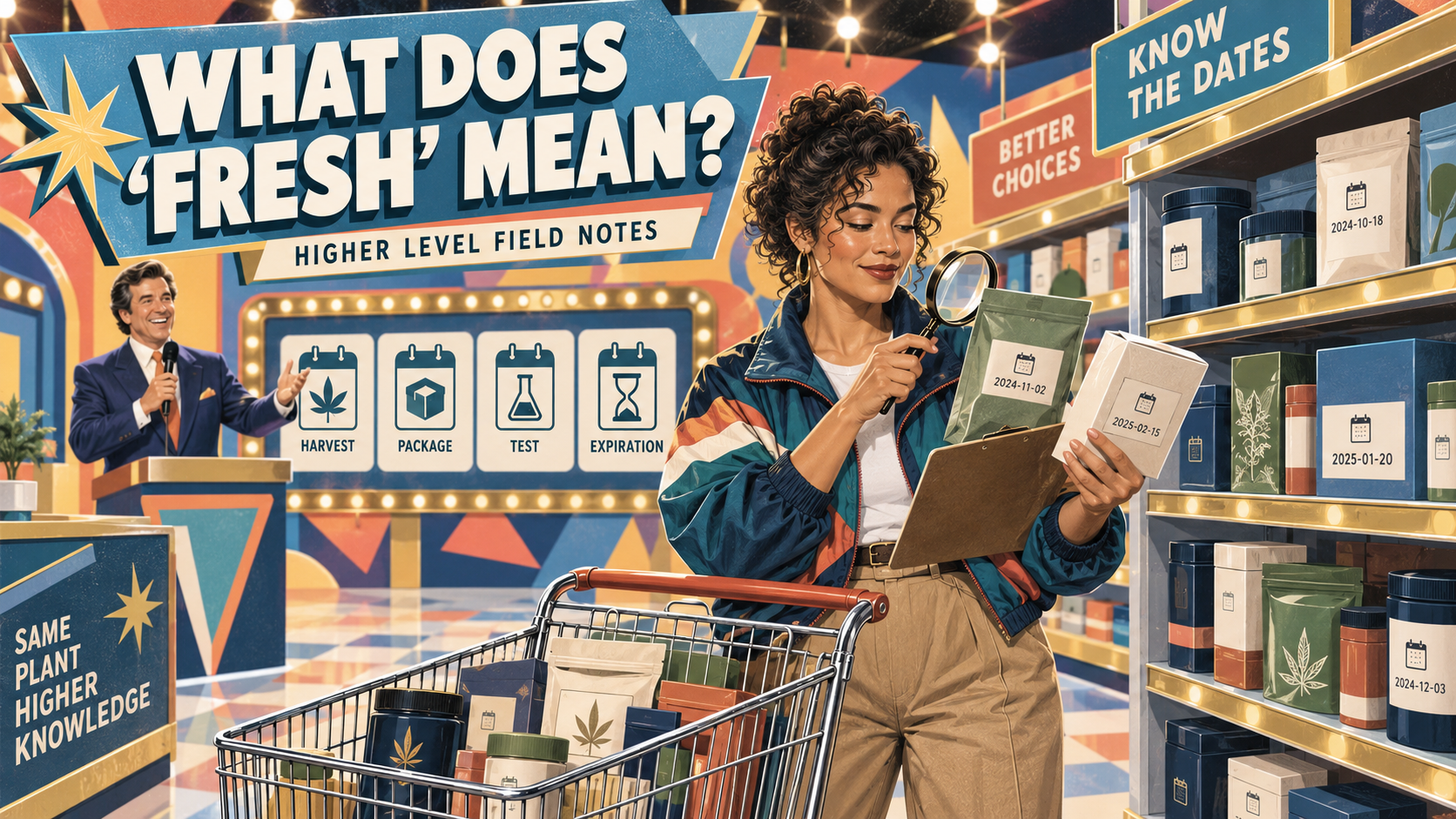
A recent date does not automatically make one cannabis product better than another, and an older date does not tell the complete story. First identify what the date represents. Then consider the format, original packaging, storage instructions, expiration date, package condition, and batch information together.
Autumn teaches us to pay attention to timing.
At the market, we look for the first apples of the season. In the kitchen, we check the bread before making toast and the milk before pouring it into coffee. A paper bag of tomatoes means something different in August than it does in November.
It is understandable that cannabis consumers bring the same instincts to a dispensary.
“When was this harvested?”
“Is this fresh?”
“Which package has the newest date?”
These are reasonable questions. They are simply not complete ones.
A date printed on a cannabis label can refer to when a plant was harvested, when a product was manufactured, when a laboratory sample was collected, when the item was packaged, or when its supported shelf life ends. Those moments are related, but they are not interchangeable.
Understanding the difference can help you evaluate a product without relying on a single number—or assuming that “newest” always means “best.”
“Fresh” can mean several different things
Freshness sounds objective, but consumers often use the word to describe several qualities at once.
Depending on the product, someone asking about freshness might really be asking:
- Has this been sitting on a shelf for a long time?
- Was it stored correctly?
- Is the package still properly sealed?
- Is the flower overly dry?
- Are the ingredients still within their labeled shelf life?
- Does the product still reflect its labeled quality?
- Has the device or container been damaged?
- Is the batch subject to a recall?
- How long has the package been open?
Those questions cannot all be answered by the same date.
The most useful first step is therefore not asking, “How old is this?” It is asking, “What does this date represent?”
A field guide to the dates
Label terminology can vary by product and producer. If the meaning of a date is unclear, ask the dispensary or manufacturer rather than guessing.
Harvest date
The harvest date generally identifies when cannabis plants were cut or collected from cultivation.
For flower and pre-roll products, this can provide useful context. It does not account for everything that happened afterward. Cannabis flower may go through drying, curing, testing, packaging, transportation, and storage before reaching a retail shelf.
A harvest date marks the beginning of the post-harvest story—not the end of it. Two products harvested on the same day may arrive in different packaging, experience different storage conditions, or reach the retailer at different times.
Production or manufacture date
For edibles, beverages, vape formulations, concentrates, tinctures, and topicals, a production or manufacture date may be more relevant than the original harvest date.
This generally refers to when the finished cannabis item was produced. It can help place the product within its expected shelf-life timeline, particularly when the item also contains food ingredients, flavoring, carrier oils, or other components.
Read it alongside the expiration date, storage directions, ingredient list, and instructions for handling the product after opening.
Packaging date
A packaging date identifies when a product was placed into its retail container or prepared for distribution.
This is not necessarily the same as the harvest or manufacture date. Some products require processing, testing, or other steps before they can be packaged and released.
A packaging date may help explain part of the timeline, but it does not independently tell you how the product was stored, whether the seal remains intact, when it was opened, whether it is included in a recall, or how much supported shelf life remains.
Sampling or testing date
A Certificate of Analysis, often shortened to CoA, may show when a representative sample was collected, received, or analyzed by a licensed testing laboratory.
The New Jersey Cannabis Regulatory Commission explains that a CoA includes product and sample information, a batch or lot number for traceability, the sampling date, and laboratory information. It also reports testing results for the sampled batch or lot.
The testing date tells you when that laboratory work occurred. It is not a universal freshness score, and it should not be confused with the day every individual retail package was produced or packed. Its value is largely about verification and traceability.
Expiration date
The expiration date deserves more attention than simply locating the youngest package on the shelf.
New Jersey’s personal-use cannabis rules require relevant cannabis labels to include production or harvest information, an expiration date, and batch or lot identification. The rules also connect assigned expiration dates to stability information and testing.
In practical terms, the expiration date identifies the period the producer has supported for that product under its stated storage conditions. It is not permission to ignore a damaged seal, leaking container, recall notice, or incorrect storage simply because the date has not arrived.
Follow the labeled expiration date. If it has passed, do not use the product. Contact the manufacturer or retailer if you need help interpreting the label or identifying the appropriate disposal process.
“Best by,” “use by,” or similar language
Some packages may include additional manufacturer language such as “best by,” “use by,” or instructions to consume a product within a certain period after opening.
Do not assume these terms all mean the same thing. Read the surrounding directions and contact the producer when their meaning is unclear.
For example, a beverage may carry an expiration date for the unopened container and separate instructions about refrigeration or use after opening. Both pieces of information matter.
The date you opened it
This one may not be printed on the package until you add it yourself.
For products with specific after-opening directions, recording the opening date can be helpful. Write it on the original package without covering required information.
This is particularly useful for products that require refrigeration, include a “use within” instruction, contain multiple servings, or could otherwise be confused with an unopened item. The manufacturer’s directions—not a universal household rule—should determine how the opening date is used.
Is the newest package always the best choice?
Not necessarily.
A more recent harvest, manufacture, or packaging date may be relevant to your decision, but date recency is only one factor. Product format, handling, packaging, storage, and personal preferences all matter.
With flower, for example, drying and curing are intentional parts of preparation. The goal is not to find a package that traveled from plant to shelf in the fewest possible days. The more useful question is whether the product was properly prepared, packaged, stored, and kept within its labeled shelf life.
With an edible or beverage, the finished product’s manufacture and expiration information may be more useful than the harvest date of the cannabis ingredient from which it was made.
With a vape product, package condition, correct storage, manufacturer instructions, and hardware integrity also matter. A recent date does not make a leaking or damaged device appropriate to use.
“Newest” can be a useful preference. It should not become a substitute for reading the rest of the label.
Freshness changes with the format
Flower
Consider the harvest or production date together with the packaging date, expiration date, seal, storage directions, and overall package condition. Do not treat scent or texture as proof that a product is safe. If you see unexpected moisture, suspected contamination, insects, or damage, stop and contact the retailer.
Pre-rolls
Evaluate pre-rolls using the dates and storage information provided by the producer. Keep the original label and batch details rather than transferring them into an anonymous case.
Edibles and beverages
Look at the manufacture date, expiration date, ingredients, allergens, refrigeration directions, instructions after opening, package condition, and servings. Keep these products clearly identified and separate from ordinary groceries.
Vapes and concentrates
Read the dates together with the manufacturer’s storage and device instructions. Do not use a cartridge, disposable device, or concentrate package that is leaking, cracked, unusually hot, or visibly compromised.
Tinctures and topicals
Follow the finished product’s expiration date and storage directions rather than judging it only by the age of the original cannabis material. Store it separately from ordinary medicine, skincare, cooking oils, and supplements.
Condition can matter more than the calendar
A product can be within its printed date and still require attention.
Pause before using it if:
- The safety seal is missing or unexpectedly broken.
- The package is cracked, punctured, swollen, or leaking.
- Required label information is unreadable.
- The contents do not appear to match the label.
- The batch or lot is listed in an official recall.
- The product was left in conditions contrary to its directions.
- You cannot confidently identify the product.
- You do not know how long it has been open.
- Something about the package or contents has changed in a concerning way.
Do not rely on tasting, smelling, or trying a small amount to investigate a potentially compromised product.
Keep the item secured in its original packaging and contact the retailer or manufacturer. Photos of the package, receipt information, and a legible batch or lot number may help them evaluate the concern.
Why the batch number belongs in the conversation
Dates help establish sequence. Batch and lot numbers establish identity.
The batch number connects a particular package to production and testing records. It can also help determine whether a product is included in a recall.
NJ-CRC recall notices may identify an affected product using its product name, manufacturer, batch number, manufacture date, package description, and reason for the recall.
A matching product name alone may not be enough. Compare all available information in the notice with the original package. If the identifying information matches an active recall, do not use the product. Follow the directions in the notice or contact the retailer.
At the counter
Better questions to ask
- Is this the harvest date, manufacture date, or packaging date?
- Where can I find the expiration date?
- How should this product be stored?
- Does it require refrigeration after opening?
- Is there a separate instruction for how long to keep it after opening?
- May I see the complete label before purchasing?
- Where is the batch or lot number?
- Is a testing summary or CoA information available?
- What should I do if the seal is damaged when I get home?
- Who should I contact with a product-quality concern?
These questions create a more complete picture without asking a budtender to predict a personal experience or make a guarantee the label cannot support.
A five-minute date check at home
- Read the complete label before storing or using the product.
- Identify what each printed date represents.
- Locate the expiration date and batch or lot number.
- Review the storage and after-opening instructions.
- Check that the package and seal appear intact.
- Keep the product in its original labeled container.
- Record the opening date if the directions make it relevant.
- Store it securely away from children and pets.
- Separate infused foods and beverages from ordinary groceries.
- Check the live NJ-CRC recall page if you have a concern.
If a label is difficult to read, take a clear photograph for your own reference before the printing rubs or fades—but keep the original package as well.
When the label is unclear
Cannabis labels contain a great deal of information in a small space. Sometimes the date format, abbreviation, or printing location is genuinely confusing.
Do not feel that you should already know what every code means.
Bring the unopened package to the attention of the dispensary team, or contact the manufacturer using the information provided on the label. Ask them to identify:
- Which date you are reading
- How the expiration date was assigned
- What storage conditions are required
- Whether the product has separate instructions after opening
- Whether a code represents a date, batch number, or another identifier
A careful question is more useful than a confident guess.
Freshness is context, not a contest
There is nothing wrong with preferring recently produced products. Many shoppers do.
The opportunity is to make that preference more precise.
Instead of treating the newest printed number as the winner, consider the complete timeline:
What was made? When was it harvested or produced? When was it tested? How was it packaged? What storage does it require? Is the seal intact? When does its supported shelf life end? Has it been opened? Can the package be traced to its batch?
That is a more thoughtful definition of fresh.
Not simply young, but identifiable. Properly packaged. Correctly stored. Within its labeled date. And accompanied by enough information to make an informed adult choice.
Ask the Collective
How Collective Beleaf can help
The Collective Beleaf team can help you locate dates, batch information, storage instructions, serving information, and other details printed on a regulated product package.
We can also help explain the difference between product formats and direct you to available manufacturer or testing information.
What we cannot do is determine the condition of a product from its date alone, extend a manufacturer’s expiration date, or guarantee a specific experience.
If you discover a damaged seal, unclear code, possible recall match, or other product concern, contact the store with the product name, manufacturer, batch number, and purchase information before visiting.
Responsible-use reminder
Cannabis is for adults 21 and older. Keep products in their original, clearly labeled packaging and securely stored away from children and pets. Keep infused foods separate from ordinary groceries. Do not use a recalled, unidentified, expired, or visibly compromised product.
Do not drive or operate machinery while impaired. Always follow the product label and applicable laws.
Higher Level content is provided for general educational and informational purposes. It is not medical or legal advice and is not a substitute for guidance from a qualified healthcare or legal professional. Product information, regulations, recall notices, and manufacturer guidance may change.
Sources and further reading
- NJ Cannabis Regulatory Commission: Personal-Use Cannabis Rules
- NJ Cannabis Regulatory Commission: Cannabis Testing Guidelines and How to Read a Certificate of Analysis
- NJ Cannabis Regulatory Commission: Cannabis Product Recalls
- NJ Cannabis Regulatory Commission: Using Cannabis Safely
- NJ Cannabis Regulatory Commission: Safe & Responsible Consumption
This article was last reviewed on September 12, 2026. Review all regulatory references, links, and approved disclaimer language again before publication.
