
Cannabis 101: How to Read a Cannabis Label Without Getting Lost
How to Read a Cannabis Label Without Getting Lost
A plain-language guide to potency, servings, ingredients, dates, warnings, and the details that deserve a closer look.
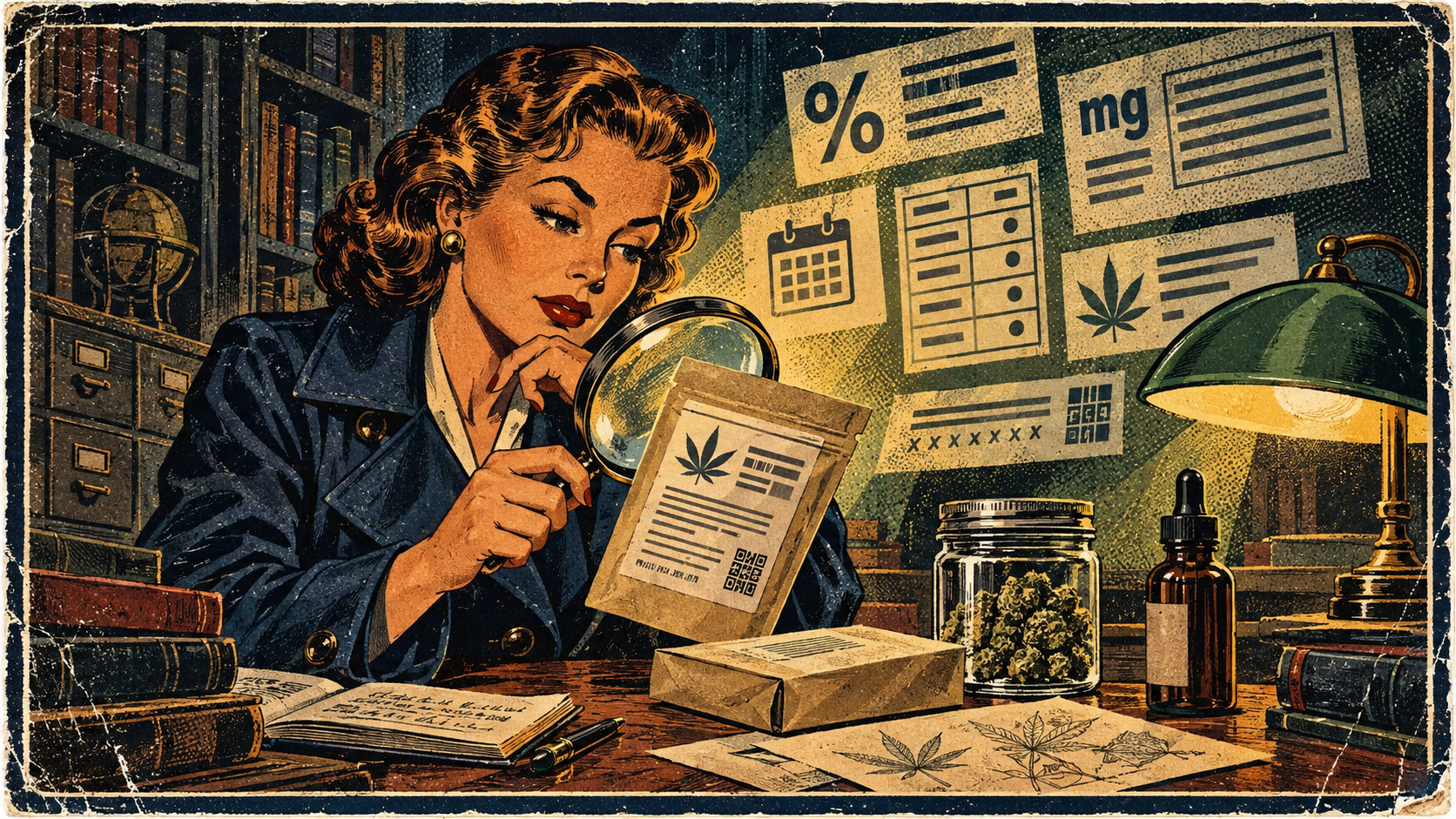
A cannabis package can fit an impressive amount of information into a very small space.
You may find percentages, milligrams, cannabinoid abbreviations, serving sizes, ingredients, batch numbers, production dates, warnings, testing information, and marketing language—sometimes spread across several panels or labels.
It is understandable to feel lost. The good news is that you do not need to interpret every number at once. A label becomes more useful when you know where to begin, which figures can be compared, and which claims require more context.
What a regulated label is designed to do
Cannabis labels identify the product and the businesses responsible for producing it, communicate cannabinoid and serving information, provide traceability details, disclose ingredients and allergens, and display required safety warnings.
In New Jersey, regulated cannabis packaging must include specific product and consumer-safety information. Packaging must also display the state’s universal cannabis symbol and applicable warnings. The exact information presented can vary by product type and package size.
A regulated label can help you make a more informed decision. It cannot tell you exactly how a product will affect you.
Identify the product before reading the potency
Begin with the basic identity of the item. Look for the product or brand name, product type, net weight or volume, infused or non-infused designation, and strain or cultivar name when provided.
This matters because the numbers are presented differently across formats. Flower and some concentrates commonly display cannabinoids as percentages. Edibles, beverages, tinctures, and other measured products commonly display cannabinoid content in milligrams.
Field note
A percentage on a flower package should not be compared directly with the milligrams shown on a gummy or beverage label. First identify the format. Then interpret its numbers in that context.
Find the total THC and CBD information
Cannabis contains compounds called cannabinoids. THC and CBD are the two most familiar, although labels may also include CBG, CBN, CBC, THCV, and others.
THC
Tetrahydrocannabinol, or THC, is an impairing cannabinoid. A regulated label may show THC information as a percentage, a number of milligrams, or both, depending on the product.
CBD
Cannabidiol, or CBD, is not intoxicating in the same way as THC. Its presence does not make a product risk-free or establish that the product will produce a particular result.
Total THC
On flower and some other products, you may see separate figures for THC and THCA alongside a figure called “total THC.” THCA is a precursor that can convert into THC when exposed to heat. New Jersey’s labeling guidance uses a calculation that accounts for this conversion when reporting total THC.
Field note
If the package provides a clearly identified total THC figure, use that figure when comparing the overall THC concentration of similar products. Do not add THC and THCA percentages together yourself.
Understand percentages versus milligrams
Percentages describe concentration
Flower labels commonly show THC and other cannabinoids as percentages of the product’s weight.
Example
This describes concentration by weight. It does not mean every use contains a standardized amount, and it does not tell you how many milligrams someone will personally consume or absorb. A higher percentage is not automatically a sign of better quality or a better match.
Milligrams describe an amount
Edibles, beverages, tinctures, and similar products commonly list cannabinoids in milligrams.
Example
10 servings per package
100 mg active THC per package
These figures describe the amount in one labeled serving, the number of servings, and the total amount in the package. Do not assume that one package, bottle, piece, or container equals one serving.
Separate “per serving” from “per package”
The most important word near a potency number may be the smallest one. Look for phrases such as per serving, per piece, per unit, per milliliter, per package, total contents, and includes multiple servings.
Reading a multi-serving label
Active THC per serving: 5 mg
Servings per package: 10
Total active THC: 50 mg
The package contains 50 milligrams in total, but each labeled serving contains 5 milligrams. The physical container does not determine the serving size—the label does.
A New Jersey note
As of this article’s review date, NJ-CRC guidance states that an adult-use ingestible package may contain no more than 100 milligrams of active THC and a single serving may contain no more than 10 milligrams of active THC. Laboratory testing uses representative samples and includes an accepted range of variability.
That regulatory maximum is not a personalized recommendation. Rules and guidance may change. Review the current NJ-CRC ingestible-labeling guidance.
“Read past the largest number. It is rarely the whole story.”
Read quantity separately from potency
Several numbers may describe completely different measurements. Net weight or volume tells you the physical quantity in the package. Cannabinoid content tells you the reported amount or concentration of cannabinoids. The unit count tells you how many individual items are included.
A one-gram vape cartridge is not necessarily 1,000 milligrams of THC. One gram describes the total product weight; the cannabinoid concentration describes how much of that product is reported as THC or another cannabinoid.
Check ingredients and allergens
Ingredients are especially important for edibles, beverages, tinctures, topicals, vapes, and infused products.
- Active cannabis ingredients
- Carrier oils
- Sweeteners and flavoring ingredients
- Color additives, emulsifiers, or preservatives
- Botanical ingredients
- Vape-oil ingredients
- Potential allergens
- Ingredients relevant to dietary restrictions
A front label may use terms such as “natural,” “plant-based,” “vegan,” or “gluten-free.” Treat these as claims that should be confirmed against the complete ingredient and allergen information.
For concentrates, the label may also include the extraction method. The NJ-CRC’s 2025 labeling addendum encourages manufacturers to disclose whether a concentrate was made using a chemical solvent or a non-chemical process.
Find the production, harvest, and expiration dates
A label may include a harvest date, production or manufacturing date, packaging date, testing date, and expiration date. These dates do not all mean the same thing.
A harvest date may appear on flower. A manufacturing date may be more relevant to an edible, vape, concentrate, or topical. An expiration date identifies the date after which the product may no longer be sold under applicable New Jersey requirements.
Dates can provide context and help determine whether a product is approaching expiration. They do not independently establish quality. Also review storage directions concerning heat, direct light, moisture, air exposure, refrigeration, and resealing.
Locate the batch, lot, and producer information
Regulated labels contain traceability details connecting the product to the licensed businesses and production batch associated with it. These may include the cultivator or manufacturer name, license number, batch or lot number, serial number, barcode, and tracking information.
These details do not predict an experience. They help identify the product if there is a quality concern, adverse event, testing question, or recall.
Keep the package
Removing a cannabis item from its labeled container can separate it from important directions, warnings, potency information, and traceability details.
Recognize the universal cannabis symbol
Cannabis products sold through New Jersey’s regulated market must display the state’s universal cannabis symbol on the packaging. When practical, the symbol is also placed on individual servings.
The symbol indicates that the package or item contains THC. It is intended to reduce accidental consumption and distinguish cannabis products from ordinary food or household products.
It is not a quality rating, potency score, brand certification, endorsement, or substitute for reading the complete label.
Read the warnings—even when they look familiar
Required warnings can be easy to overlook, especially when they appear in small print. New Jersey labels include applicable warnings addressing adult use, children, pregnancy and breastfeeding, driving, Poison Control, delayed effects for ingestibles, high-potency products, and electronic smoking devices.
Certain formats require additional language. For example, ingestible products must warn that intoxicating effects may be delayed by two or more hours.
Field note
A warning is not decorative legal language. It may contain information specific to the format, concentration, or intended use of the product.
What about terpenes?
Terpenes are aromatic compounds found in cannabis and many other plants. They contribute to aroma and flavor, and a laboratory summary may list major terpenes such as myrcene, limonene, pinene, linalool, caryophyllene, or terpinolene.
Terpene information can help describe an aroma profile. It should not be treated as a dependable promise that a product will make every person feel relaxed, energetic, focused, sleepy, creative, or social.
What do “sativa,” “indica,” and “hybrid” tell you?
These terms are often used as broad product categories, but they should not be treated as precise predictions. Products placed in the same category may have different cannabinoid concentrations, terpene profiles, formulations, and individual effects.
The same caution applies to words such as uplifting, relaxing, creative, energizing, sleepy, social, daytime, or nighttime. These may describe brand positioning, reported experiences, or general expectations. They are not individualized guidance or guaranteed outcomes.
What is a Certificate of Analysis?
A Certificate of Analysis, often called a COA, is a laboratory report associated with a tested batch. It may include results related to cannabinoid potency, terpenes, microbial contaminants, pesticides, heavy metals, residual solvents, and other required testing categories.
Some packages provide a QR code or website link connected to testing information. Do not assume every QR code serves the same purpose; confirm where it leads.
Laboratory testing is generally conducted on a representative batch sample rather than every individual item. Results should be understood as batch-level information within the applicable testing framework—not a perfect measurement of every package.
Marketing language versus regulated information
Cannabis packaging has two voices. One is regulatory: it communicates product identity, potency, servings, ingredients, warnings, dates, and traceability. The other is promotional: it may describe aroma, flavor, cultivation philosophy, intended occasion, brand story, or anticipated experience.
Give more weight to
- Product type
- Total cannabinoid information
- Amount per serving
- Total package content
- Ingredients and allergens
- Directions and warnings
- Dates and batch information
Treat with context
- Lifestyle descriptions
- Effect promises
- “Premium” or “top shelf”
- “Clean” or “natural”
- “Craft” or “best”
- Daytime or nighttime positioning
- Unverified wellness claims
New Jersey rules prohibit false, misleading, or deceptive cannabis labeling. Even so, consumers should distinguish measurable product information from subjective descriptions.
Five questions to ask when a label is unclear
- Is this number per serving or for the whole package?
- How many servings are in the container?
- Does this percentage describe total THC or only one measurement?
- Is this product infused, and what was added to it?
- Which statements come from testing, and which are brand descriptions?
A trained dispensary team member should be able to help locate information and explain how the label is organized. They should not diagnose a condition, promise a result, or replace advice from a qualified healthcare professional.
The label-reading order to remember
Identify. Measure. Divide. Check. Confirm.
Identify the product format.
Measure the cannabinoid content and package quantity.
Divide the total from the amount per serving.
Check ingredients, dates, directions, and warnings.
Confirm anything you do not understand before purchasing or using the product.
The goal is not to become a cannabis chemist in the aisle. It is to understand what you are holding well enough to make an informed adult choice.
Read past the largest number. Take your time. Keep the package. Ask the question.
Sources
- NJ-CRC Packaging and Labeling Guide for Adult-Use Cannabis
- NJ-CRC Packaging and Labeling Guide Addendum, February 2025
- NJ-CRC Guidance for Labeling Total Active THC in Ingestibles, updated August 12, 2026
- NJ-CRC Safe and Responsible Consumption
- CDC Cannabis Frequently Asked Questions
Information was checked against these sources during drafting. Regulations and agency guidance may change. Review all time-sensitive information and links before publication.
