
Recipe at a glance
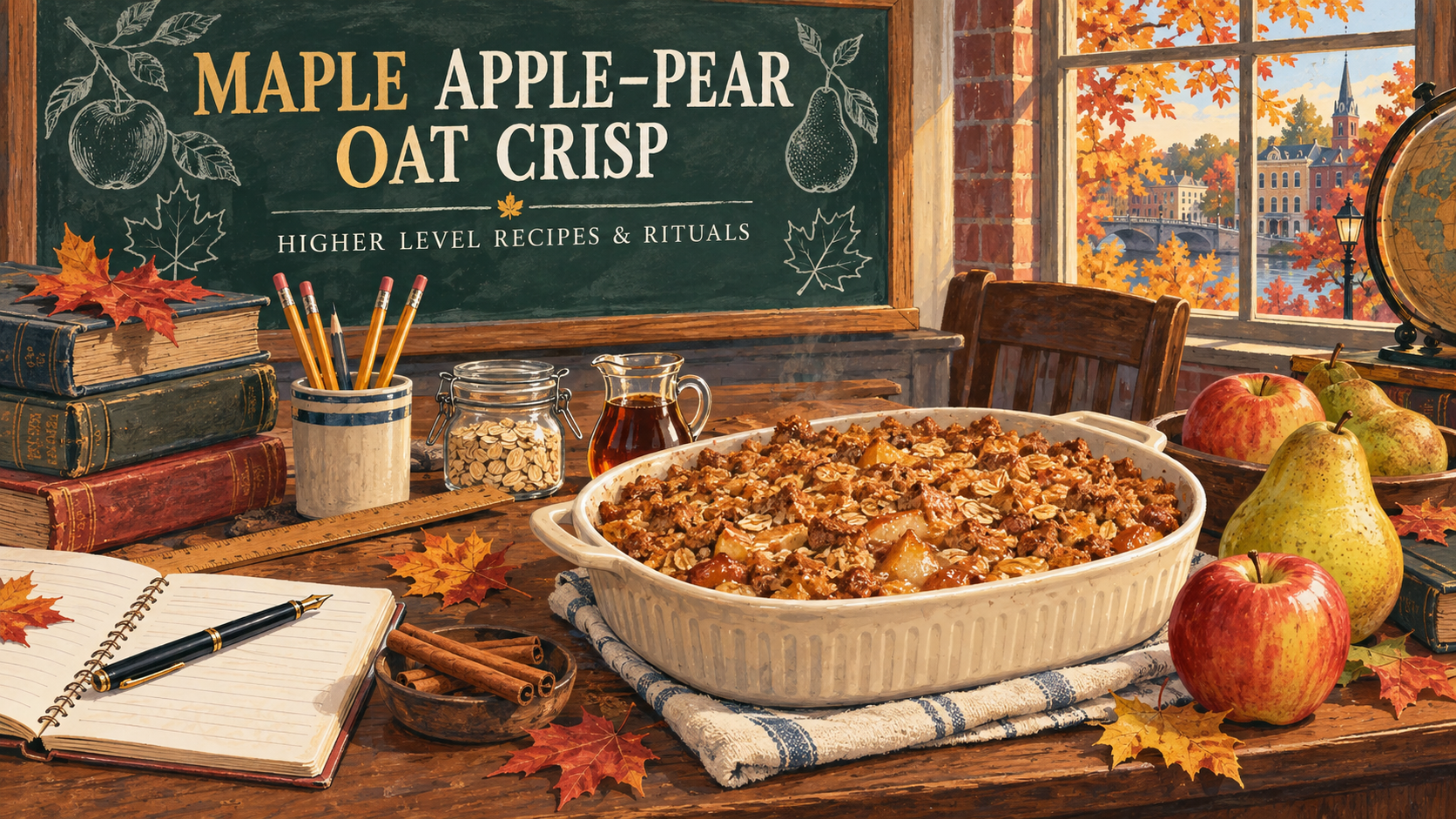
Maple Apple–Pear Oat Crisp
- Recipe type
- Dessert
- Version
- Adaptable
- Preparation
- 25 minutes
- Cooking
- 40–45 minutes
- Total time
- About 1 hour 10 minutes
- Servings
- 8
- Difficulty
- Approachable
- Base recipe
- Non-infused
Dietary notes: Vegetarian as written. For a nut-free version, omit the pecans and verify every packaged ingredient. A dairy-free version requires a verified dairy-free butter alternative. A gluten-free version requires certified gluten-free oats and a verified one-to-one gluten-free baking flour.
Some autumn recipes announce themselves from the oven.
Apples soften. Maple gathers at the edges of the baking dish. Cinnamon drifts into the next room, followed by the unmistakable scent of butter, oats, and toasted sugar.
This crisp is designed for that kind of afternoon: a farm-stand bag on the counter, a cool window cracked open, and nowhere particularly urgent to be.
Using apples and pears together gives the filling a little contrast. Apples provide structure and brightness; pears become softer and more floral as they bake. Maple syrup rounds out the fruit without turning the dish into a sugar project, while the oat topping stays intentionally uneven—some parts crisp, some crumbly, and some soaked with the juices below.
The base recipe is completely non-infused. It can remain that way.
For adults who choose to prepare a cannabis-infused adaptation, a separate section explains what must be known, calculated, labeled, and reviewed before cannabis is added. No potency is assumed or supplied.
A note on choosing the fruit
Use apples that hold some shape when baked. Firm, tart or balanced varieties work especially well, but there is no need to turn the recipe into a search for one perfect apple.
The pears should be ripe enough to smell fragrant near the stem but still firm enough to slice. Very soft pears can disappear into the filling before the apples are tender.
A mixture of varieties is welcome. An imperfect farm-stand apple is welcome, too. Trim bruised areas and use fruit that is otherwise sound.
Peeling is optional. Leaving some or all of the skin in place gives the filling more texture and color. If using thicker-skinned fruit, peeling may create a more tender result.
Equipment
- 9-inch square or similar 2-quart baking dish
- Large mixing bowl
- Medium mixing bowl
- Cutting board and chef’s knife
- Measuring cups and spoons
- Citrus juicer or small bowl
- Flexible spatula or wooden spoon
- Rimmed baking sheet, to catch possible drips
- Digital scale, optional but helpful
- Lockable storage container if preparing an infused version
Recipe card
Ingredients
Apple–pear filling
- 3 medium firm apples, approximately 1½ pounds
- 3 medium firm-ripe pears, approximately 1½ pounds
- 2 tablespoons pure maple syrup
- 1 tablespoon fresh lemon juice
- 1 teaspoon vanilla extract
- 1 tablespoon cornstarch
- 1 teaspoon ground cinnamon
- ¼ teaspoon ground ginger
- ⅛ teaspoon ground nutmeg
- ¼ teaspoon fine salt
Oat topping
- 1 cup old-fashioned rolled oats
- ¾ cup all-purpose flour
- ⅓ cup packed light or dark brown sugar
- ½ cup chopped pecans, optional
- 1 teaspoon ground cinnamon
- ¼ teaspoon fine salt
- 6 tablespoons unsalted butter, melted and cooled slightly
For serving, optional
- Plain yogurt
- Vanilla ice cream
- Lightly whipped cream
- Additional toasted pecans
- A small drizzle of maple syrup
Method
Instructions
-
Prepare the oven and baking dish
Position a rack in the center of the oven and preheat it to 350°F. Lightly butter or oil a 9-inch square baking dish. Place the dish on a rimmed baking sheet if it is especially full or shallow.
-
Prepare the fruit
Core the apples and pears. Peel them completely, leave the skins on, or use a mixture of peeled and unpeeled fruit. Cut the fruit into slices or chunks approximately ½ inch thick. Place it in a large mixing bowl.
-
Season the filling
Add the maple syrup, lemon juice, vanilla, cornstarch, cinnamon, ginger, nutmeg, and salt. Fold gently until the fruit is evenly coated and no dry pockets of cornstarch remain. Transfer the filling to the prepared dish.
-
Make the oat topping
Combine the oats, flour, brown sugar, pecans if using, cinnamon, and salt. Pour in the melted butter and stir until evenly moistened and small and medium clusters begin to form.
-
Assemble the crisp
Scatter the topping evenly over the fruit. Do not pack it firmly. Leaving small openings allows steam to escape and some fruit juices to bubble through.
-
Bake
Bake for 40–45 minutes, until the fruit bubbles around the edges and a knife inserted near the center meets tender fruit with a little remaining structure. If the topping browns too quickly, loosely cover the dish with foil near the end.
-
Rest before serving
Cool for at least 20 minutes. This allows the filling to settle and thicken. Serve on its own or with one of the optional accompaniments.
Non-infused version
Prepare it exactly as written
If the crisp will be served where cannabis may also be present, identify this dish explicitly as non-infused so guests do not have to wonder.
Suggested label:
MAPLE APPLE–PEAR OAT CRISP
NON-INFUSED
Clear labeling is helpful in both directions. It prevents accidental consumption of infused food and allows adults who do not want cannabis to choose confidently.
Adaptation option one
Adapt one individual serving
Preparing the entire crisp without cannabis and adapting only one adult portion offers the clearest separation.
This approach may be preferable when:
- Some guests do not consume cannabis
- The household includes children or pets
- The dessert will be served at a shared table
- An exact whole-dish estimate cannot be completed
- Avoiding accidental sharing is a priority
- Different adults have different preferences
Prepare and bake the crisp exactly as written. Only after it has been portioned should an adult-specific serving be adapted using a precisely measured amount of a legally purchased, clearly labeled product that the manufacturer identifies as suitable for the intended use.
Do not heat, bake, or mix a cannabis product into food unless its directions support that use.
Keep the adapted serving physically separate from ordinary portions. Place it on a distinct plate, identify it clearly, and do not leave it unattended. The exact product and measured quantity must still be entered into the cannabinoid-information record below.
Adaptation option two
Adapt the entire crisp
A whole-dish infusion requires greater care because every portion depends on accurate measurement, thorough distribution, and consistent serving size.
Do not prepare the whole-dish infused version until all of the following are known:
- The exact cannabis product
- The labeled cannabinoid concentration
- The precise quantity being used
- The estimated total cannabinoid content contributed by that quantity
- The final number of servings
- The method used to distribute the product throughout the recipe
- The calculation used to estimate the amount per serving
- The product’s directions concerning heat and culinary use
If using a butter- or oil-based cannabis ingredient, the amount used must replace part of the recipe’s regular butter—not be added on top of the six tablespoons already listed.
Regular butter: 6 tablespoons minus the measured cannabis-containing butter or oil
Cannabis-containing ingredient: 20 mL of tincture
Total combined fat: 6 tablespoons
This keeps the culinary proportions intact. It does not establish cannabinoid potency. Use a scale or appropriately graduated measuring tool; do not estimate by eye.
Mix the measured cannabis-containing ingredient thoroughly with the remaining melted butter before adding it to the topping. Even distribution cannot be guaranteed, which is why all per-serving numbers must be described as estimates.
Divide the finished crisp into eight reasonably equal portions. If the yield changes, recalculate using the actual number of servings.
Cannabinoid-information record
Complete every field. Never guess potency.
- Cannabis product used
- Daily Drops Tincture
- Manufacturer
- Treeworks
- Labeled cannabinoid concentration
- 500 mg CBG, 100 mg CBD, and 100 mg THC
- Exact quantity used
- 20 mL
- Regular butter used:
- 70 mL, approximately 4 tablespoons plus 2 teaspoons
- Total fat and tincture mixture:
- 90 mL, equivalent to the recipe’s original 6 tablespoons of butter
- Estimated total cannabinoid content
- 400 mg CBG / 80 mg CBD / 80 mg THC
- Number of servings
- 8, unless the actual yield changes
- Estimated content per serving
- 500 mg CBG / 10 mg CBD / 10 mg THC
Preparation Instructions
- Measure exactly 20 mL of tincture using a milliliter-marked oral syringe or graduated measuring device. Do not estimate using an unmarked dropper.
- Melt 70 mL of unsalted butter over low heat. Remove it from the heat as soon as it becomes liquid.
- Add the 20 mL of tincture to the melted butter.
- Whisk thoroughly for at least 60 seconds, scraping the bottom and sides of the container.
- Use the complete 90 mL mixture in the oat topping.
- Mix the topping thoroughly before distributing it evenly over the fruit.
- After baking and cooling, divide the finished crisp into exactly eight equal portions. Weighing the finished crisp and portioning it by weight will be more consistent than cutting by sight.
If the source product, labeled potency, quantity used, or number of servings is missing, do not calculate or publish an estimated cannabinoid amount.
Do not calculate from a product name, strain name, package color, general category, or expected effect.
How to calculate the estimate
Milligrams per unit
Labeled cannabinoid content per unit × number of units used = estimated total cannabinoid content
Milligrams per milliliter or gram
Labeled concentration × exact milliliters or grams used = estimated total cannabinoid content
Measured fraction of a package
Total labeled content × verified fraction used = estimated total cannabinoid content
For each method:
Estimated total cannabinoid content ÷ actual number of servings = estimated cannabinoid content per serving
Do not perform a percentage-based conversion unless the label supplies enough verified information and the calculation is reviewed by someone qualified to interpret it. Do not count the cannabinoid content of an entire package when only part was used. Do not assume every visible portion contains an identical amount.
Preparation and mixing record
For an infused version, record:
- Whether the manufacturer permits the intended culinary use
- Whether the product was exposed to heat
- The temperature and length of heat exposure
- The tool used to measure the product
- How the cannabis-containing ingredient was combined with the regular ingredients
- How long the mixture was stirred
- The final number of portions
- Whether portions were weighed or measured
- Any product lost in a bowl, utensil, or container
- Any deviation from the published recipe
Do not claim that mixing or portioning was perfectly uniform. If an important measurement or preparation note was not recorded, do not reconstruct it from memory later.
Storage and labeling
Non-infused crisp
Cover and refrigerate leftovers promptly. For conservative household food-safety practice, use refrigerated leftovers within three to four days. FoodSafety.gov recommends keeping the refrigerator at 40°F or below and provides additional information through its Cold Food Storage Chart.
Reheat only the portion you intend to serve.
Infused crisp
An infused crisp requires additional controls:
- Transfer it to a clearly labeled container.
- Mark it CANNABIS-INFUSED — ADULT USE ONLY.
- List the cannabis product and preparation date.
- Include the total number of servings.
- Include the estimated content per serving only when calculable.
- Include the standardized estimate warning.
- Keep it physically separate from ordinary food.
- Store it in a locked location.
- Keep it away from children, adolescents, pets, and unsuspecting adults.
- Do not use an ordinary bakery box or unlabeled food container.
- Prevent accidental sharing or unidentified take-home portions.
The New Jersey Cannabis Regulatory Commission advises keeping cannabis in its original, clearly labeled packaging, locking it away from children and pets, and storing edibles separately from other food.
Keep the original cannabis-product packaging with the infused-food record so its potency, batch, manufacturer, warnings, and directions remain available.
A note for gatherings
An infused dessert should never be placed beside ordinary food without clear separation.
- Use visibly different serving dishes.
- Keep the infused version in an adult-controlled area.
- Label both versions.
- Use separate utensils.
- Assign one informed adult to control the infused dish.
- Do not allow self-service without first showing the label.
- Prevent accidental sharing or unidentified take-home portions.
- Return the infused version to locked storage promptly.
A handwritten “special” or “adult” label is not specific enough. Use the words cannabis-infused clearly.
Responsible-use notice
This recipe is intended only for adults 21 and older where adult-use cannabis is legal.
Never serve cannabis-infused food to anyone without their knowledge and explicit consent. Keep infused foods securely stored, clearly labeled, and separated from ordinary food. Keep them away from children and pets.
Do not drive or operate machinery after consuming cannabis. Do not combine cannabis with alcohol or other substances without understanding the potential risks. Follow the product label, applicable laws, purchasing and possession limits, and approved responsible-use guidance.
Cannabis products, preparation methods, portion sizes, and individual experiences vary. This recipe does not provide medical treatment, a personalized dose, or a guarantee of effects.
If cannabis may interact with a medication or health condition, consult a qualified healthcare professional.
